Agents ask me this question more than almost anything else: "Does video actually help sell a house faster, or is it just a nice-to-have?" Fair question. Nobody wants to spend money on marketing that looks good in a presentation deck but does not move the needle where it counts.
So I went through every credible study I could find from NAR, Zillow, Realtor.com, REA Group, and a handful of independent MLS analyses. The answer is not "it depends" in some vague, consultant-approved way. The data is surprisingly clear. Video listings outperform photo-only listings on nearly every metric that matters: inquiries, time on market, final sale price, and seller acquisition.
Here is what the research actually says, what it does not say, and how agents can use it without overthinking the production side.
The headline stats: what the major studies found
Before we get into nuance, these are the numbers that come up repeatedly across multiple sources and methodologies. They are not cherry-picked from a single study with a sample size of fourteen.
| Metric | Finding | Source |
|---|---|---|
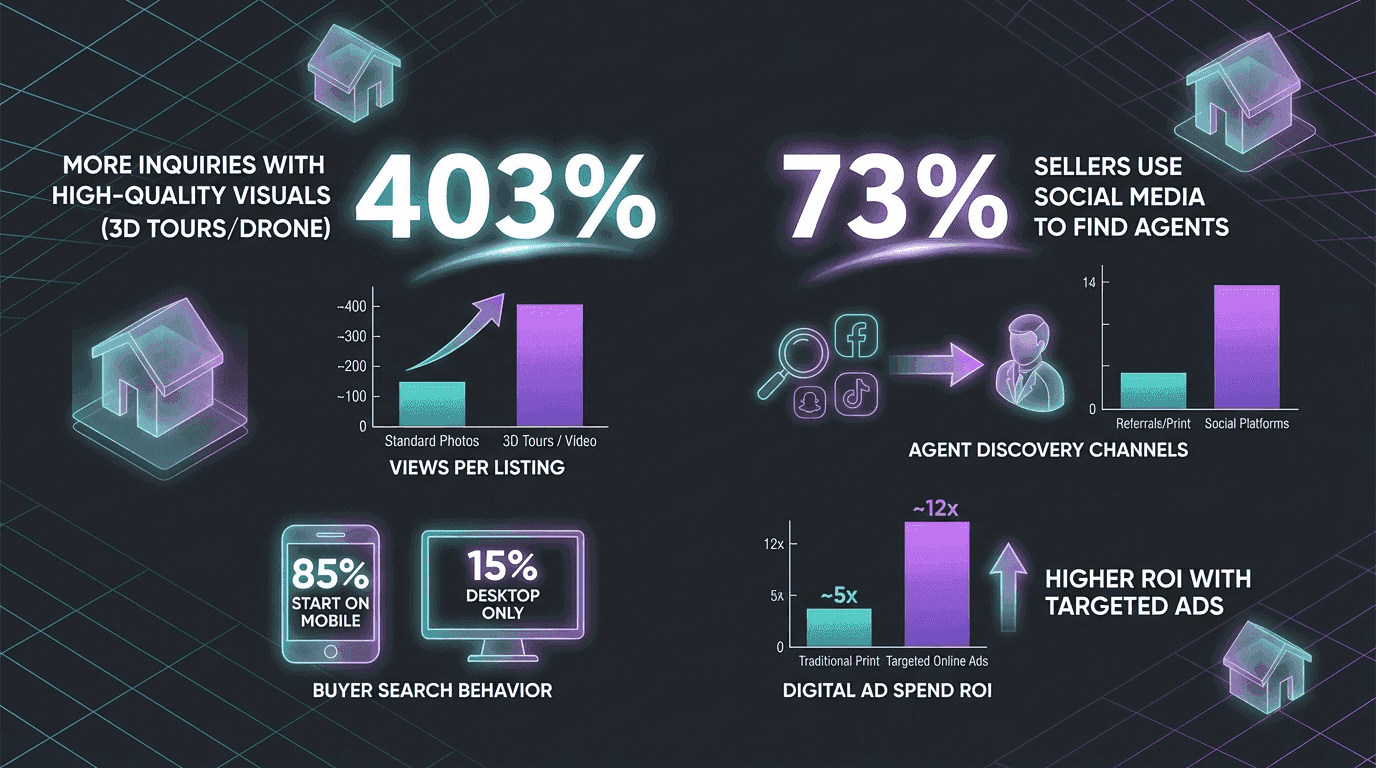
| Inquiry volume | 403% more inquiries for video listings | REA Group (realestate.com.au), 2023 |
| Seller preference | 73% of homeowners prefer listing with agents who use video | NAR 2024 Profile of Home Buyers and Sellers |
| Time on market | Video listings sell up to 32% faster | Zillow internal data, 2023-2024 |
| Final sale price | Homes with video sell for an average of 6% above asking | Realtor.com analysis, 2023 |
| Search engagement | Listings with video receive 4x more saves and shares | Zillow consumer behavior study, 2024 |
| Agent selection | Agents who use video grow revenue 49% faster than those who do not | NAR Technology Survey, 2024 |
These numbers are large enough that even if you discount them by 30% for methodology bias, the conclusion still holds. Video listings consistently outperform photo-only listings.
Let me break down what each of these actually means for a working agent.
403% more inquiries: where that number comes from
The 403% figure comes from REA Group, which operates realestate.com.au, one of the largest property portals in the world. They compared inquiry rates on listings that included video against listings that used photos only, controlling for property type, price range, and market conditions.
Four times more inquiries does not mean four times more showings or four times more offers. Inquiries are the top of the funnel. But a wider top of the funnel reliably produces more activity downstream. More inquiries mean more showings, more competitive tension, and stronger negotiating position for the seller. That is the mechanism that leads to faster sales and stronger final prices.
The skeptical take is that video listings might just attract more casual browsers who click "inquire" without serious intent. That is partly true. But even accounting for tire-kickers, the net effect on qualified leads remains strongly positive. Zillow's own engagement data shows that buyers who watch a listing video spend 5-8x longer on the listing page and are 2x more likely to schedule a showing than buyers who view photos only.
73% of sellers prefer agents who use video
This one is about winning the listing, not selling it. According to NAR's 2024 Profile of Home Buyers and Sellers, nearly three out of four homeowners say they would choose an agent who uses video marketing over one who does not, all other things being equal.
That stat should terrify any agent who still leads listing presentations with a printed CMA and a promise to "get professional photos." Professional photos are table stakes now. They have been table stakes for years. Video is the new differentiator in the listing presentation, and sellers know it because they have been watching listing videos on Zillow, Redfin, and Instagram for the last five years.
I have heard agents say "my sellers don't care about video." That is almost always a misread. What sellers actually do not care about is the technical details of how video gets made. They care very much about whether their home will look impressive online compared to the house down the street. Video makes that comparison easier to win.
There is also a compounding effect here. Agents who use video on every listing build a visible portfolio that makes the next listing presentation stronger. A seller who searches your name and sees ten polished AI listing videos is already more impressed than a seller who finds ten static photo galleries. The marketing asset becomes a business development asset.
32% faster sales: what drives the speed difference
Zillow's internal analysis of listing performance data between 2023 and 2024 found that listings with video content sold up to 32% faster than comparable listings without video. The "up to" qualifier matters. The effect varies by market, price point, and property type. But even the lower-bound estimates show a meaningful reduction in days on market.
Why would video make a listing sell faster? Three reasons.
1. Better pre-qualification. Buyers who watch a video arrive at the showing with a clearer picture of the property. They already know the layout, the light, the feel of the rooms. This means fewer "just looking" showings and more serious conversations. Agents report that buyers who viewed the listing video before a showing are measurably more engaged and more likely to make an offer.
2. Faster emotional connection. Photos show rooms. Video shows movement, flow, and atmosphere. A kitchen in a photo is a kitchen. A kitchen in a video, with a slow orbit around the island and warm light hitting the countertops, feels like a place where someone might actually cook dinner. That emotional connection accelerates decision-making in a way that additional photos rarely do.
3. Broader reach in the first 72 hours. The first three days of a listing are the most important for engagement. Video gives the listing more surface area across platforms: MLS, Zillow, Realtor.com, Instagram, Facebook, TikTok, YouTube, and the agent's own property website. More channels mean more eyeballs in that critical launch window, which means more showing requests compressed into a shorter timeframe.
The 32% faster figure also connects to the broader real estate video statistics showing that video content consistently reduces the consideration period for serious buyers. They feel like they have "seen" the home before visiting, which shortens the gap between first impression and offer.
6% above asking: the price premium effect
Realtor.com's 2023 analysis found that homes marketed with video sold for an average of 6% above asking price. On a $500,000 home, that is $30,000. On a $750,000 home, that is $45,000.
The mechanism here is competitive tension. When a listing generates more interest (remember, 403% more inquiries), it creates a more competitive bidding environment. More interested buyers showing up in the same timeframe pushes offers higher. Video is not magic. It is a demand amplifier. More demand in a fixed supply situation (one house) drives price.
There is a subtler effect, too. Video positions the property as premium before anyone walks through the door. A listing with a well-produced video signals that the seller and agent are serious, that the home has been properly staged and photographed, and that this is not a distressed or lazy listing. That psychological framing affects what buyers are willing to offer.
I have seen this play out with Reel-E customers specifically. Agents who add video to every listing report that sellers notice when the competition does not have video. The absence of video on a neighboring listing makes the video listing look more polished by comparison. It is a relative game, and video tips the scale.

What the data does NOT prove
Intellectual honesty matters here. These statistics are compelling, but they come with caveats that I rarely see other blog posts acknowledge.
Correlation is not causation. Agents who use video tend to be more marketing-savvy overall. They probably also take better photos, write better descriptions, stage more carefully, and price more accurately. The video itself might not be doing all the heavy lifting. It might be a proxy for "this agent takes marketing seriously," and that broader effort is what actually produces the results.
Market conditions matter. A listing with video in a hot seller's market might sell fast regardless. The marginal impact of video is probably larger in balanced or buyer's markets where differentiation actually determines which listings get attention and which get ignored. In a market where every listing gets twelve offers in 48 hours, video is less decisive (though still useful for the listing presentation).
Video quality varies enormously. A shaky phone walkthrough with bad lighting and no music is technically "video," but it is not the kind of video that produces 403% more inquiries. The studies that show strong results are measuring competently produced video content. A bad video can actually hurt a listing by making it look unprofessional. This is why the "how" of video production matters as much as the "whether."
The 6% price premium is an average, not a guarantee. Some video listings sell below asking. Some photo-only listings sell above asking. The average tells you about the general direction, not any specific outcome. Agents should use video because it improves the odds, not because it guarantees a specific result.
None of these caveats change the fundamental conclusion. They just mean agents should think about video as a high-probability advantage rather than a silver bullet.
Why most agents still are not using video (and why that is changing)
Given how strong the data is, why do only about 26% of agents use video marketing consistently? (That number comes from NAR's own surveys, and it has been stubbornly low for years.)
The answer is not that agents are lazy or unaware. It is that traditional video production has three problems that make it impractical for most listings.
Cost. A professionally produced listing video typically runs $500 to $2,000 per property. For agents who sell 10-20 homes a year, that is $5,000 to $40,000 annually in video production costs alone. The math does not work on a $300,000 starter home where the commission is already thin. Check our full breakdown of real estate video costs for the numbers.
Time. Booking a videographer, coordinating access, waiting for editing and revisions, approving the final cut. The typical turnaround for a traditional listing video is 3-7 business days. By the time the video is ready, the listing has already been live for a week and the initial burst of buyer attention has passed. The marketing asset arrives too late to capture the launch window.
Scalability. Even if an agent can afford one listing video, doing it for every listing requires a repeatable system. Traditional production does not scale. Each video is a project: scheduling, shooting, editing, revising. Multiply that by 15 listings and the operational burden becomes unsustainable without dedicated production staff.
These barriers explain why the adoption rate stays low even though the data is compelling. Agents are not irrational. They are responding to a real cost-benefit problem. The benefits of video are clear, but the traditional production model makes those benefits hard to capture consistently.
That is also why the market is shifting toward AI-powered real estate video makers that solve the cost, time, and scalability problems simultaneously. When you can produce a listing video in two minutes from photos you already have, the calculus changes completely.
The ROI math: what video marketing actually returns
Let me run through a concrete example because abstract percentages are hard to act on.
Say you are an agent in Tampa who sells 15 homes a year at an average price of $425,000. Your average commission is 2.5%, so each sale generates about $10,625 in gross commission.
| Scenario | Calculation | Annual Impact |
|---|---|---|
| One additional sale per year from video marketing | $10,625 x 1 | +$10,625 |
| 6% price premium on half your listings | ($425,000 x 6% x 2.5%) x 7.5 homes | +$4,781 |
| One new listing won via video portfolio | $10,625 x 1 | +$10,625 |
| Total incremental revenue | +$26,031 |
Against that, what does video cost? With a traditional videographer at $800 per listing, you would spend $12,000 annually for 15 videos. With an AI real estate video tool, you might spend $50-150 per month, or $600-1,800 per year. The ROI on AI video is roughly 14x to 43x.
Even the conservative ROI on traditional video production (roughly 2x) makes it a good investment. But the AI video ROI is so lopsided that not using it starts to look like leaving money on the table.
And those numbers do not account for the indirect benefits: seller referrals from impressive marketing, faster listing turnover that lets you take more clients, and the compounding effect of a visible video portfolio on your personal brand.
Platform-specific data: where video matters most
Not all platforms reward video equally. Here is what the data shows about where video has the most impact.
MLS and portal listings
Zillow, Realtor.com, and most MLS systems now support embedded video. Zillow's own data shows that listings with video get 2x more page views and 4x more saves than photo-only listings. The video also keeps users on the page longer, which improves the listing's visibility in Zillow's recommendation algorithm. More engagement means more algorithmic distribution means more buyers seeing your listing.
Check our guide on MLS video requirements for the technical specs each system expects.
Instagram and TikTok
Social platforms are where real estate video marketing strategy gets interesting. Instagram's algorithm heavily favors Reels over static posts. TikTok is entirely video-native. Agents who post listing videos on these platforms regularly report 5-10x more reach than agents who post photos.
The social data also skews younger, which matters more than most agents realize. First-time buyers (ages 25-35) are the fastest-growing buyer demographic, and they discover properties on social media at higher rates than any other age group. If you are not producing video content for social, you are invisible to a significant chunk of the buyer pool.
Property websites
Single-property websites with video have a 60% lower bounce rate and 3x longer session duration than sites with photos only. This is important because video marketing in real estate is not just about distribution. It is about conversion. A buyer who spends three minutes watching a video on your property site is far more qualified than one who glances at five photos and bounces.
What kind of video works best for listings?
Not all listing videos are created equal. The data supports a few clear patterns about what works and what does not.
Cinematic property tours outperform slideshows. A video with actual camera movement, smooth transitions, and music synchronized to the visual pacing gets significantly more engagement than a slideshow of photos with crossfades. Buyers can tell the difference, and platforms can too (Instagram's algorithm measures watch-through rate, and slideshows get abandoned faster).
60-90 seconds is the sweet spot for social. For MLS and property websites, 2-3 minutes works well because the audience is already interested. For social media, keep it under 90 seconds. Attention drops off sharply after that. Our analysis of optimal real estate video length goes deeper on this.
Both branded and unbranded versions matter. MLS compliance often requires unbranded video. Social media and property sites benefit from branded video with your logo and contact information. The best workflow produces both formats from the same source material. (This is exactly why Reel-E generates four video variants per listing: horizontal branded, horizontal unbranded, vertical branded, vertical unbranded.)
Music quality is underrated. Bad stock music makes a good video feel cheap. Properly licensed, beat-synced music makes transitions feel intentional rather than random. This is one of those details that separates "agent made this in an app" from "this looks like a production company made it."
How agents can start using video today (without the production headaches)
If you have read this far, you are probably in one of two camps: either you already use video and want data to justify continuing, or you do not use video and are trying to figure out whether it is worth the effort.
For the second group, here is the most practical path to getting started.
Step 1: Use photos you already have. You do not need a separate video shoot. If you are already getting professional listing photos (and you should be), those photos can be turned into cinematic video using AI tools that generate camera movement, transitions, and beat-synced music automatically. Photo-to-video conversion eliminates the biggest barrier to entry: cost and scheduling.
Step 2: Automate the production. Manual video editing is what kills adoption. Every hour you spend in a video editor is an hour you could spend with clients. Look for tools that handle the entire workflow: upload photos, select music, get finished video. With Reel-E, that process takes about two minutes. The AI handles camera motion, transitions synced to the music's downbeats, branded and unbranded versions, and both horizontal and vertical formats.
Step 3: Distribute everywhere. One listing video should go to at least four places: MLS, your property website, Instagram/TikTok (vertical cut), and your email drip to buyer leads. If you are only putting video on one platform, you are leaving most of the ROI on the table. The platform-specific video specs vary, which is why having both horizontal and vertical versions ready at launch matters.
Step 4: Build the habit, then optimize. The biggest mistake agents make is treating video as a special event. "I will use video on my next luxury listing." That misses the point. The data says video improves outcomes on all listings, not just expensive ones. A $325,000 three-bedroom in a suburban subdivision benefits from video just as much (proportionally) as a $2M waterfront estate. Start using video on every listing, measure the results for 90 days, and then decide what to adjust.
The competitive window is closing
Here is the uncomfortable truth about the 26% adoption rate. It means that right now, in 2026, using video on your listings still gives you a significant competitive advantage because most agents are not doing it. You are the agent with the impressive listing presentation while three out of four competitors show up with photo galleries and a "coming soon" promise about video.
That window will not stay open forever. AI video tools are making production so fast and affordable that adoption will accelerate. When 70% of agents use video, the advantage disappears. It becomes table stakes, just like professional photos did. The agents who adopted early will have years of video portfolio, established social media presence, and seller relationships built on demonstrably better marketing.
The agents who wait will be playing catch-up from a standing start.
If the data in this article convinced you that video is worth doing, the next step is just starting. Try Reel-E free and turn your next listing's photos into a finished video in about two minutes. No videographer, no editing software, no learning curve. Just photos in, video out.
FAQ
Do video listings actually sell faster than photo-only listings?
Yes. Zillow's internal data shows video listings sell up to 32% faster than comparable photo-only listings. The effect is strongest in balanced and buyer's markets where differentiation determines which listings get attention.
How many more inquiries do video listings get?
According to REA Group data, listings with video receive 403% more inquiries than listings without video. Even accounting for casual browsers, the net effect on qualified leads and showings is strongly positive.
Do sellers prefer agents who use video?
NAR's 2024 survey found that 73% of homeowners prefer to list with agents who use video marketing. Video has become a differentiator in listing presentations, similar to how professional photography became expected a decade ago.
What is the ROI of video marketing for real estate agents?
For agents using AI video tools, the ROI ranges from roughly 14x to 43x when accounting for additional sales, price premiums, and new listings won through a visible video portfolio. Traditional videographer ROI is lower (roughly 2x) due to higher per-listing costs.
How much does it cost to add video to a listing?
Traditional videography runs $500-$2,000 per listing. AI video tools like Reel-E cost $50-$150 per month for unlimited listings, making the per-listing cost negligible. See our real estate video cost breakdown for detailed comparisons.
What kind of listing video works best?
Cinematic property tours with actual camera movement, beat-synced music, and smooth transitions outperform photo slideshows with crossfades. The ideal length is 60-90 seconds for social media and 2-3 minutes for MLS and property websites.
Do I need a videographer to create listing videos?
Not anymore. AI tools can generate cinematic listing videos from existing listing photos in minutes. This eliminates the cost, scheduling, and turnaround barriers that kept most agents from using video. For premium or architecturally distinctive homes, a hybrid approach (AI baseline plus selective human production) can make sense.
Which platforms benefit most from listing video?
Zillow and MLS listings with video get 2-4x more engagement. Instagram and TikTok heavily favor video content in their algorithms. Single-property websites with video have 60% lower bounce rates and 3x longer session duration.
Is it too late to start using video for my listings?
No. Only about 26% of agents use video consistently. The competitive advantage of video is still significant, but it will shrink as AI tools drive wider adoption. Starting now builds a portfolio and workflow advantage that compounds over time.
Can AI-generated listing videos compete with professionally filmed ones?
For the vast majority of listings, yes. AI video tools now generate genuine camera movement (orbits, push-ins, pull-outs) rather than simple slideshows. The quality gap has narrowed to the point where most buyers cannot distinguish AI-generated listing video from traditionally produced content, especially in the MLS and social media contexts where listings are actually consumed.